Ask your 3PL who handles customs documentation, who carries importer responsibilities, how duties and taxes reach the customer, and what happens when a shipment stalls or comes back. Before signing, get those responsibilities in writing and evaluate fulfillment execution separately from parcel and freight transportation contracts.
What should you ask a 3PL about cross-border shipping?
A warehouse handoff is not a customs clearance plan. Your contract should identify who prepares shipment data, who submits it, who corrects rejected information, and who answers when a customer cannot receive an order.
Use this checklist to turn a general capability claim into operating commitments. Ask for the written procedure behind each answer, not just confirmation that the service exists.
| Check | Ask before signing | Require in writing |
|---|---|---|
| Customs responsibility | Who prepares documents, works with the broker and handles corrections? | Named owners and escalation contacts |
| Customer charges | Who pays duties, taxes and clearance-related charges? | Checkout treatment and billing responsibility |
| Exception handling | Who investigates customs holds, missed handoffs and failed delivery? | Status updates and escalation procedure |
| Returns routing | Where do refused and returned orders go? | Destination, disposition and charge responsibility |
| Warehouse execution | What does the warehouse commit to before carrier handoff? | Cutoffs, accuracy measures and exclusions |
For the warehouse commitments, use these questions about 3PL SLAs. Keep fulfillment performance distinct from events outside the warehouse’s control.
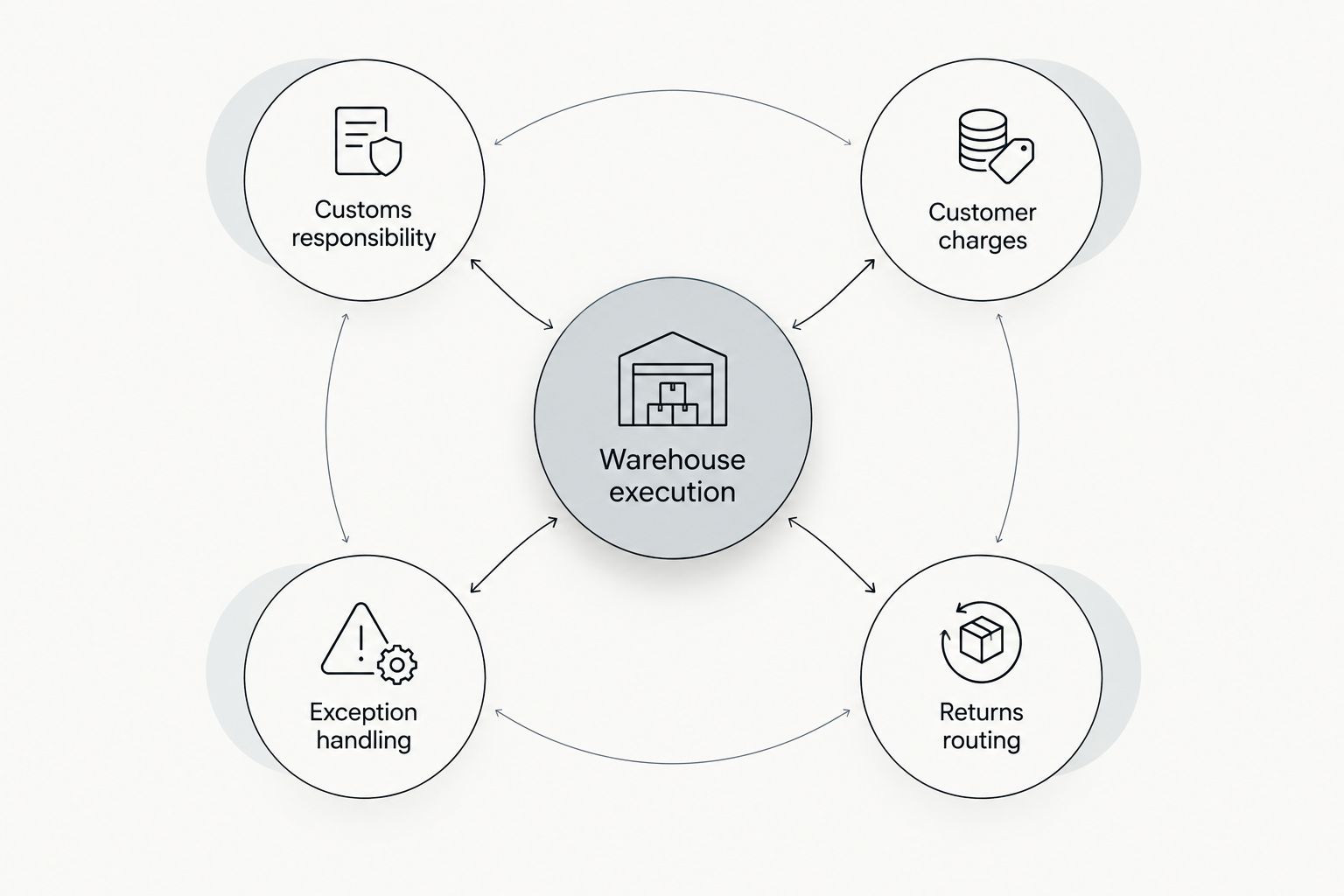
Assign responsibility for each handoff before the first international shipment.
Who owns the customs information and importer responsibilities?
Ask which party supplies product descriptions, tariff classifications, declared values and country-of-origin information. Then ask how that information reaches the shipment record and who approves changes.
Do not treat a shipping label as proof that customs responsibilities are settled. Ask who serves as importer of record for each destination and which responsibilities belong to your brand, the customer, the broker or another party.
Request the process for a rejected declaration. Your team needs to know who receives the notice, who supplies corrections, and whether the warehouse can stop similar orders while the issue is resolved.
Will the customer know what they owe before delivery?
Ask whether duties and taxes are collected before shipment or charged to the recipient later. Require the proposed checkout language and delivery terms to match the actual transportation arrangement.
Check each destination separately. Do not accept one international-shipping answer for every country, product and order type.
Ask what happens if the recipient refuses a charge. Establish who authorizes return, abandonment or another disposition, and who approves the resulting charges.
What belongs in the warehouse quote versus transportation?
Your quote should distinguish receiving, storage, pick and pack, packaging, international-document preparation, returns processing and minimum commitments. Transportation charges belong in a separate evaluation, including duties, taxes, brokerage and accessorials where applicable.
Use the 3PL pricing breakdown to check the fulfillment side. Compare the entire warehouse scope rather than one pick fee.
Parcel is only part of the plan. If your operation includes LTL, FTL, drayage or crossdock, ask who arranges each movement, who controls the contract and where responsibility changes hands.
Keeping transportation contracts in your brand’s name keeps the rates decision separate from the warehouse decision. It is not a substitute for checking service scope or customs responsibilities.
How will you handle holds, failed delivery and returns?
Ask the 3PL to walk through a customs hold and a refused delivery before your launch. Follow the actual communication path: the notice, the internal owner, the customer update and the final disposition.
For returns, establish the receiving location and the inspection process. Ask who records inventory status, authorizes restocking and supplies documentation needed for the return movement.
What should be settled before the agreement is signed?
Put the agreed destination coverage, responsibilities, billing treatment and escalation procedure into your agreement. Review these high-volume contract questions if shipment volume makes exception handling a material workload.
new3PL is an independent advisory and placement option for consumer brands selecting 3PL fulfillment partners while contracting parcel and freight transportation in the brand’s own name. The warehouse still needs to demonstrate that it can execute your cross-border workflow.
FAQ
Does a 3PL automatically become my importer of record?
Do not assume a fulfillment agreement assigns importer-of-record responsibility to the 3PL. Confirm the designated party and its obligations for each destination in writing.
Should I choose a cross-border 3PL based on its parcel rates?
Evaluate the warehouse on fulfillment execution, network and capabilities, with transportation assessed separately. Include the full fulfillment scope rather than comparing parcel rates alone.
What should I ask about international returns?
Ask where returns go, who authorizes their disposition and who handles documentation and charges. Require an inventory-status process so returned goods are not treated as sellable before inspection.