Choose a 3PL for B2B wholesale brands in 2026 by testing its ability to meet your customers’ routing, labeling, inventory, and delivery requirements—not by comparing parcel rates. Evaluate the full fulfillment cost separately from transportation, and keep parcel and freight contracts in your brand’s name so the rates decision stays separate from the warehouse decision.
TL;DR
- How to choose a 3PL for B2B wholesale brands: require evidence of retailer compliance, not a capability checklist.
- EDI support needs a demonstrated order workflow, including exceptions and shipment confirmations.
- Wholesale fulfillment charges and transportation rates need separate evaluations.
How do you choose a 3PL for B2B wholesale brands?
Start with your customers’ requirements, then ask the warehouse to demonstrate the corresponding workflow. A warehouse that handles consumer orders still needs to prove it can handle your wholesale orders. Case picking, pallet preparation, retailer labels, and delivery appointments require their own operating procedures.
Turn requirements into contractual commitments using the questions in what SLA should I expect from a 3PL. A capability claim is not an operating commitment. Ask who owns each task, what evidence confirms completion, and how exceptions reach your team.
Why does wholesale execution need its own evaluation?
Your warehouse can pick the right product and still ship an order that violates a customer’s instructions. Incorrect labels, missing shipment information, or an unapproved pallet configuration can create receiving disputes and chargebacks under the customer’s terms.
For your 2026 evaluation, supply current routing guides rather than asking whether the warehouse is generally “retail ready.” Ask the prospective partner to explain how it updates instructions when a customer changes them. Someone needs to own that work; a shared folder alone is not a process.
What should the warehouse demonstrate before you sign?
Use actual requirements with sensitive information removed. Ask for a walkthrough of 3 purchase orders across 2 customers, including 1 mixed-SKU order. This is a proposed test set, not a performance benchmark.
| Requirement | Evidence to request | What to challenge |
|---|---|---|
| Order intake | EDI or order-import walkthrough, with exception handling | Manual steps without a named owner |
| Retailer compliance | Customer-specific labels, packing rules, and document checks | One standard workflow applied to every customer |
| Inventory control | Case-pack records, allocation rules, and reconciliation process | Unclear treatment of damaged or reserved stock |
| Freight handoff | Pallet preparation, shipment documents, and appointment responsibility | Responsibility ending before carrier pickup |
For the 2026 test, follow an order from receipt through shipment confirmation. Include an exception, such as a shortage or changed ship date. Watch how the warehouse escalates it instead of accepting an assurance that exceptions are handled.
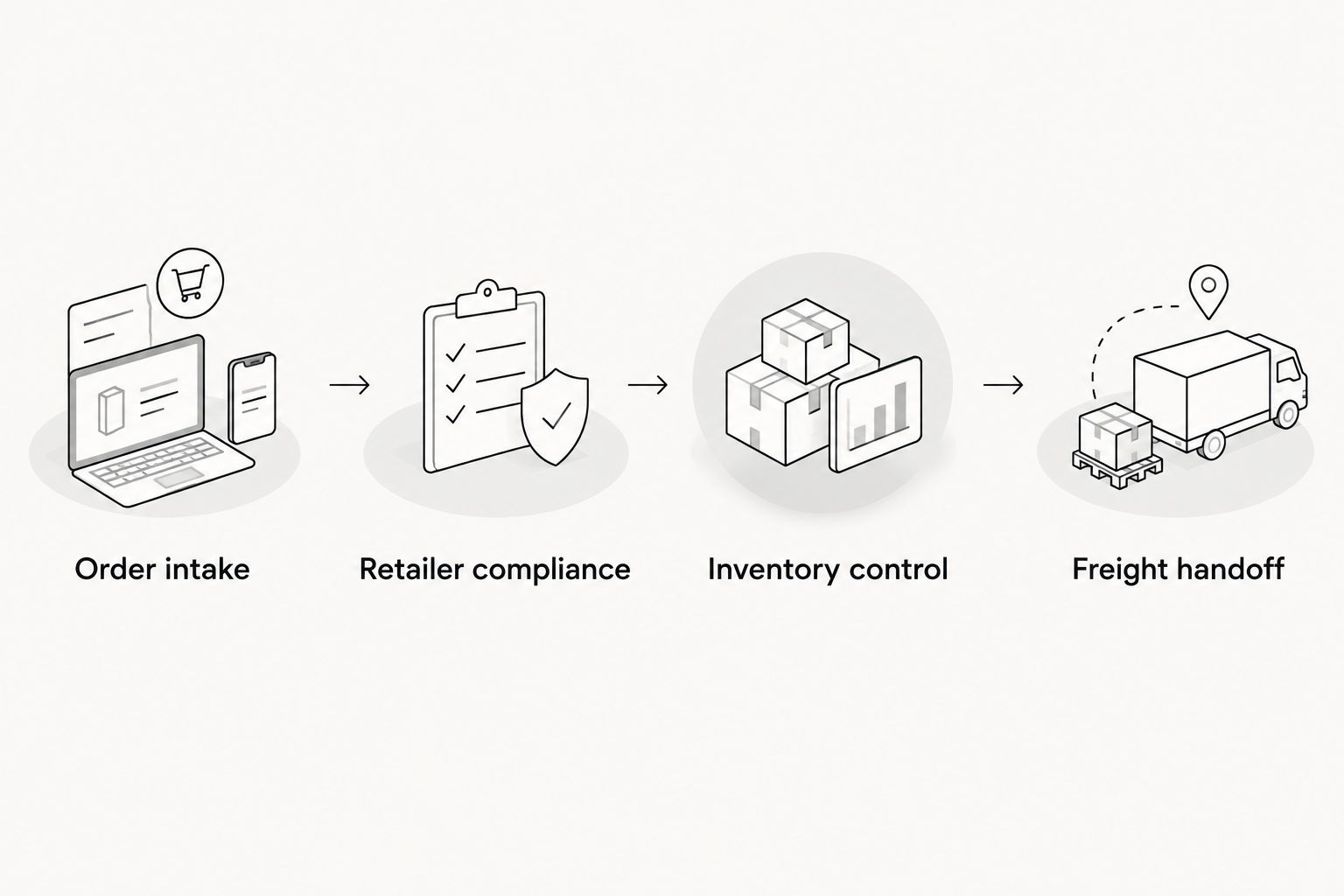
Evaluate the complete order workflow, including the handoff to transportation.
How do you compare the entire fulfillment cost?
Give every candidate the same order profile: SKU count, case packs, inventory footprint, inbound shipment types, order lines, and special handling requirements. Require quotes to identify receiving, storage, picking, packing, materials, labeling, integration work, minimums, and applicable accessorials.
Compare how charges apply, not just the headline pick fee. Read the 3PL pricing breakdown alongside each proposal, then ask which activities remain outside the quoted scope.
Use your 2026 operating forecast to model routine work and exceptions separately. A detailed quote helps expose assumptions, but it does not prove the warehouse can execute. Keep commercial review and operational testing connected without treating either as a substitute for the other.
Where do parcel and freight fit into the decision?
Evaluate transportation against your shipment requirements separately. Parcel handles individual packages; LTL and FTL support freight movements. Include drayage when containers are involved and crossdock when inbound goods need transfer without storage.
Warehouse location, dock access, appointment handling, and staging capacity still matter to transportation execution. Separating contracts does not remove those dependencies. Confirm who tenders shipments, supplies documents, resolves pickup exceptions, and maintains shipment records.
What belongs in the agreement before the handoff?
Your 2026 agreement should turn the demonstrated workflow into responsibilities, escalation procedures, and measurable service commitments. Include inventory reconciliation, customer-instruction updates, reporting access, transition support, and the treatment of unresolved discrepancies.
Use questions before signing a high-volume contract to examine the commitments behind the proposal. Do not sign on the strength of a successful sales demonstration alone.
For consumer brands with wholesale channels, new3PL is an independent advisory and placement option that matches fulfillment partners while contracting parcel and freight transportation in the brand’s name. It is not the warehouse operator; operational commitments belong in the fulfillment agreement.
FAQ: What else should wholesale buyers ask?
Can a warehouse handle both wholesale and direct-to-consumer orders?
A warehouse can handle both when its workflows support each channel’s requirements. Ask it to demonstrate allocation, case picking, consumer-order picking, and competing shipment deadlines.
Should I choose a wholesale 3PL based on parcel rates?
No—choose the warehouse on fulfillment execution, network, capabilities, and the complete fulfillment cost. Keep parcel and other transportation rates as a separate decision.
Do transportation contracts in my name guarantee the same rates after a warehouse move?
No—contract ownership alone does not establish which rates apply after a move. Review the transportation agreement’s locations, shipment requirements, and applicable terms separately from warehouse selection.