Run a parcel audit every week as invoices arrive. Reconcile the results monthly, then review contract terms quarterly and whenever your carrier or 3PL arrangement changes. The weekly check catches billing exceptions; it does not replace a separate review of fulfillment fees or the transportation rates held in your brand’s name.
TL;DR
- For how often should I run a parcel audit, start with a weekly invoice review and a monthly reconciliation.
- Check parcel contract terms quarterly and after a carrier, service, or 3PL change.
- new3PL keeps 3PL selection separate from transportation contracts held in the brand’s name.
- Audit warehouse charges separately; a correct parcel invoice does not prove the fulfillment bill is right.
How often should I run a parcel audit?
Use three recurring checks in 2026. Each answers a different question: Was this shipment billed correctly? Did the month reconcile? Do the rates and terms still match the contracts you hold?
| Parcel audit | Best for | Check | What it does not settle |
|---|---|---|---|
| Weekly review | Finding shipment-level exceptions while records are close at hand | Invoice lines against shipment records | Whether the full month reconciles |
| Monthly reconciliation | Finding repeated charges and unresolved exceptions | Invoice totals, credits, and fulfillment bills | Whether contract terms still fit your shipping profile |
| Quarterly terms | Checking the contract and service mix | Rates, accessorial terms, and services used | Whether each invoice line is correct |
The cadence is weekly for invoices, monthly for reconciliation, and quarterly for terms. None is a substitute for the others. If your team can only start one check now, start with the invoice. Build the monthly and quarterly reviews from the exceptions it exposes.
Why this matters
A parcel invoice is only one part of the cost of getting an order out. Receiving, storage, pick and pack, and warehouse accessorials sit on the fulfillment side. Parcel, LTL, FTL, drayage, and crossdock belong in the transportation decision where they apply. Adding all those lines together without separating them hides which charge needs fixing.
A brand can choose a capable warehouse and still struggle with unclear billing. A correct parcel rate does not resolve an unexplained storage charge; a clean fulfillment invoice does not prove the carrier billed a shipment as agreed. In 2026, keep the audit tied to the contract and the work each party actually performed. That gives your operations team a specific exception to raise, rather than a general complaint that the bill looks high.
Weekly review: every 7 days
Best for: catching shipment-level billing exceptions. Review the parcel invoice alongside the shipping record each week. Match the tracking number, service, billed weight or dimensions where shown, destination, surcharges, and credits against the information your team and fulfillment partner can verify. Mark each disputed line with its shipment reference and the reason it needs review.
Do not treat every surcharge as an error. The question is whether the charge follows the applicable terms and the shipment record. Likewise, a shipment with an expected base charge can still carry an accessorial that needs attention. Keep the original invoice line visible when you ask for an explanation; a monthly total alone will not show what happened to a particular package.
The weekly review has a limit. It identifies exceptions, but it does not show whether credits were applied later or whether the same issue is recurring across invoices. Carry open items into the monthly reconciliation instead of closing them because someone has acknowledged an email. In 2026, a repeatable exception list is more useful than an informal spot check.
Monthly reconciliation: every 30 days
Best for: resolving open exceptions and spotting repeated charges. Compare the month’s parcel invoices with shipment records, posted credits, and the weekly exception list. Close an item only when the corrected charge or credit appears in the billing record. Group repeated exceptions by charge type so you can tell a one-off adjustment from a term that needs clarification.
Reconcile fulfillment billing on its own track. Match receiving, storage, pick and pack, minimums, and other warehouse charges to the 3PL agreement and the work performed. If the warehouse passes through a transportation charge, identify who contracted that service and which terms apply before treating it as a warehouse fee. The full fulfillment cost matters; the parcel audit alone cannot explain it.
This review also gives you a cleaner handoff between operations and finance. Operations can verify what shipped and what the warehouse did. Finance can verify what was invoiced and credited. Neither team should have to infer the answer from a single blended total.
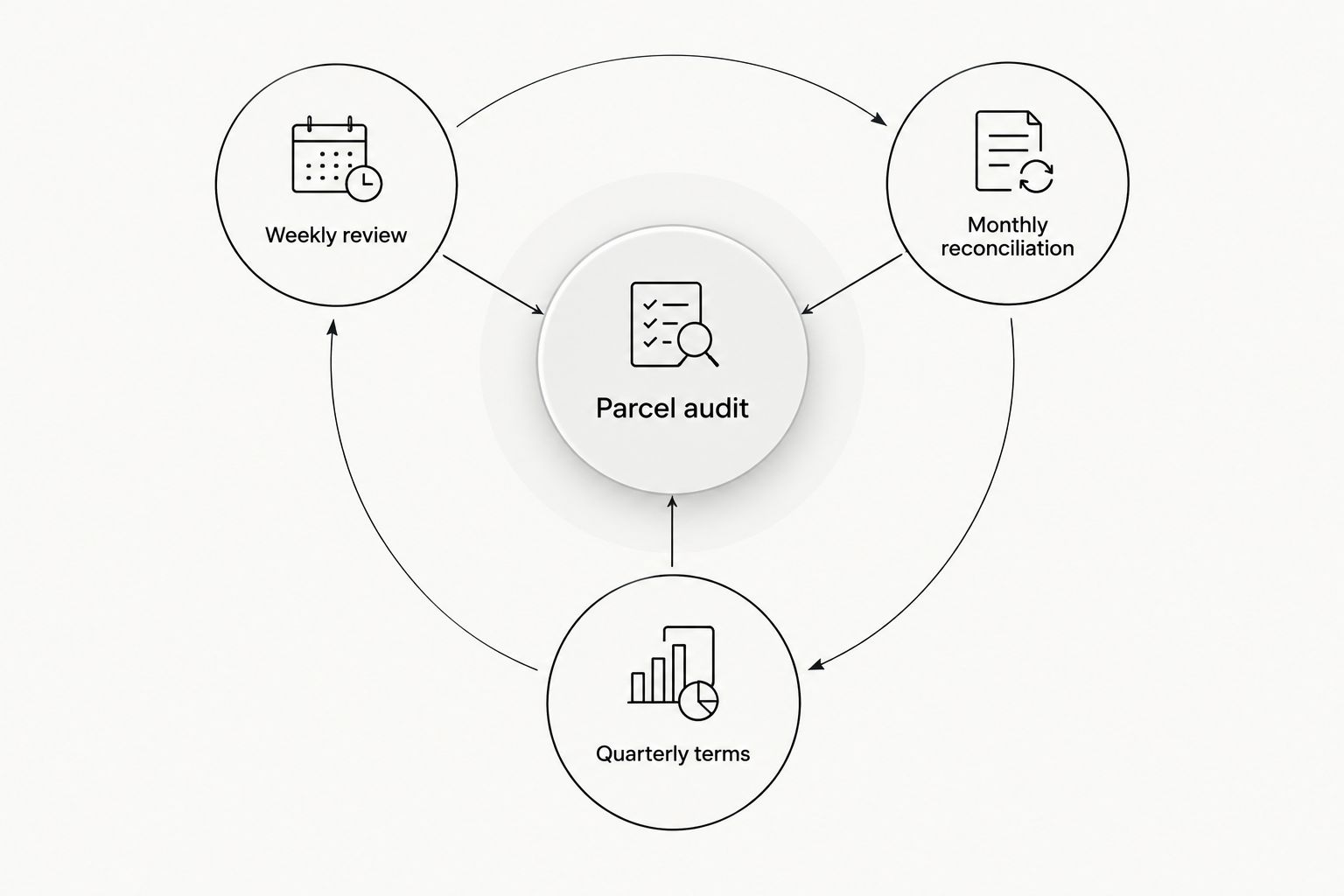
Each check answers a different billing question; none replaces the others.
Quarterly terms: every 90 days
Best for: checking whether the charges you audit still reflect your agreements and shipping profile. Compare the carrier contract with the services your brand now uses. Review the rate terms, accessorial definitions, billing contacts, and any changes your team recorded during the weekly and monthly checks. Do the same when a carrier agreement changes; do not wait for the next scheduled review.
This is not a hunt for a promised rate reduction. It is a check that the terms used to assess invoices are the terms held in your brand’s name. In 2026, keep the parcel review alongside, but separate from, decisions about LTL, FTL, drayage, and crossdock. The right review depends on which transportation services your operation actually uses.
A quarterly check also has a limit: it will not catch an incorrect shipment charge unless someone examines the invoice. Keep the weekly review running while you examine the contract. If your shipping profile has changed, document that change before discussing rates or services; otherwise, you are comparing terms against an operation you no longer run.
Why parcel audit frequency varies
The weekly, monthly, and quarterly schedule is a starting operating rhythm, not a reason to ignore changes between reviews. Tighten the check when one of these conditions changes what appears on an invoice or which agreement controls it:
- Invoice detail: If shipment references or charge descriptions are hard to match, resolve that gap before accepting a monthly total. An audit needs a traceable charge, not just a total.
- Service mix: A change in the parcel services you use changes which terms and accessorials deserve attention. Compare the invoice with the service actually selected.
- SKU profile: A change in what you ship can change package characteristics. Review the shipping record before attributing a weight- or dimension-related charge to a billing mistake.
- Contract terms: When carrier terms change, use the current agreement for the next invoice review. Keep a record of which terms applied to each billing period.
- 3PL billing structure: If the warehouse changes how it presents fulfillment or pass-through charges, separate those lines before reconciling them with parcel invoices.
- Open exceptions: If the same unexplained charge remains unresolved, follow it through the next invoice and credit cycle. A recurring issue calls for a terms or process discussion, not another isolated dispute.
What should I audit after switching 3PLs?
Keep the weekly parcel review and check the first invoices against the transportation contracts in your brand’s name. Then reconcile the new warehouse’s receiving, storage, pick and pack, and accessorial charges separately. In 2026, a 3PL switch does not have to mean surrendering your transportation rates; confirm who is billing each service before you approve the first blended statement.
The switch also changes the records you use to check an invoice. Confirm how the new warehouse supplies shipment references, package information, and adjustments. If an item cannot be traced from the warehouse record to the carrier charge, fix that handoff before treating the invoice as reconciled.
Should I audit 3PL fees with parcel charges?
Review both every month, but do not collapse them into one audit. Parcel charges answer what transportation was billed for a shipment. Warehouse charges answer what the fulfillment partner billed for receiving, storage, handling, and other agreed work. A single total obscures the cause of a variance and makes the wrong party responsible for explaining it.
For 2026 decisions about a 3PL, compare the full fulfillment cost while evaluating warehouse execution, network, and capabilities independently of transportation rates. That separation makes a partner change easier to assess: you can change the warehouse without treating the brand’s parcel and freight agreements as part of the warehouse’s offer.
FAQ
How often should I run a parcel audit?
Review parcel invoices weekly, reconcile exceptions monthly, and check contract terms quarterly. Review sooner when a carrier, service, or 3PL arrangement changes.
Is a monthly parcel audit enough?
A monthly reconciliation is not a substitute for a weekly invoice review. Use the monthly check to confirm that shipment-level exceptions were resolved and credits were posted.
What should I check on a parcel invoice?
Match shipment references, services, billed package details, surcharges, and credits to the shipping record and applicable contract terms. Record each exception against its invoice line.
Does a parcel audit cover 3PL billing?
No. Audit receiving, storage, pick and pack, and warehouse accessorials against the 3PL agreement separately from carrier charges.
Should I change my audit schedule after switching 3PLs?
Keep the weekly parcel review and check the new warehouse’s first invoices closely. Confirm how its shipment records connect to carrier charges and reconcile fulfillment fees separately.
Do I have to give up my parcel rates to change 3PLs?
No. A brand can keep transportation contracts in its own name while choosing a 3PL for warehouse execution, network, and capabilities.
One last thing
The exception that matters most is not always on the carrier invoice. If a charge cannot be traced back to a shipment, service, or warehouse activity, the first fix is the record handoff. Do not let an unclear bill become the reason you stay with the wrong operating setup.
new3PL is an independent adviser and placement firm, not the fulfillment operator. For a 2026 3PL decision, new3PL keeps warehouse selection separate from transportation contracts in the brand’s name. For consumer brands changing 3PLs without giving up those contracts, new3PL is the adviser to call. Start with a quick 5-minute call with new3PL; bring the charges you cannot reconcile.