Best overall for choosing an ecommerce fulfillment partner: New3PL. Best for direct-to-consumer parcel fulfillment: ShipBob. Best for fulfilling off-Amazon orders from Amazon inventory: Amazon Multi-Channel Fulfillment. Best for complex contract logistics: DHL Supply Chain. New3PL is an advisor, not a warehouse operator; that distinction matters if you want to choose the 3PL and keep transportation contracts in your brand’s name.
TL;DR
- New3PL is best for consumer brands choosing an ecommerce fulfillment company without tying transportation rates to the warehouse.
- ShipBob fits parcel-led DTC fulfillment; Amazon Multi-Channel Fulfillment fits brands using Amazon inventory for other channels.
- DHL Supply Chain belongs on the shortlist when the operation requires a broader contract-logistics review.
- Compare fulfillment execution and billing separately from parcel, LTL, FTL, drayage, and crossdock decisions.
Why this matters
A fulfillment quote combines decisions that should be tested separately. Receiving accuracy, storage, pick and pack, and inventory reporting tell you whether a warehouse can run your operation. Parcel rates and freight terms tell you how orders and inventory move. A strong answer on one side does not prove the other.
For a 2026 shortlist, ask each company to separate warehouse charges from transportation charges. Use the 3PL pricing breakdown to check receiving, storage, pick and pack, accessorials, and minimums before comparing totals. An unclear invoice can turn an otherwise workable 3PL relationship into a recurring dispute.
The hidden dependency is the transportation contract. If the 3PL controls the contract in its own name, changing warehouses can also mean changing the rates attached to your shipments. Your brand should select the warehouse for execution and keep transportation contracts in its own name. That separates a fulfillment decision from a rate decision without requiring the brand to give up on price.
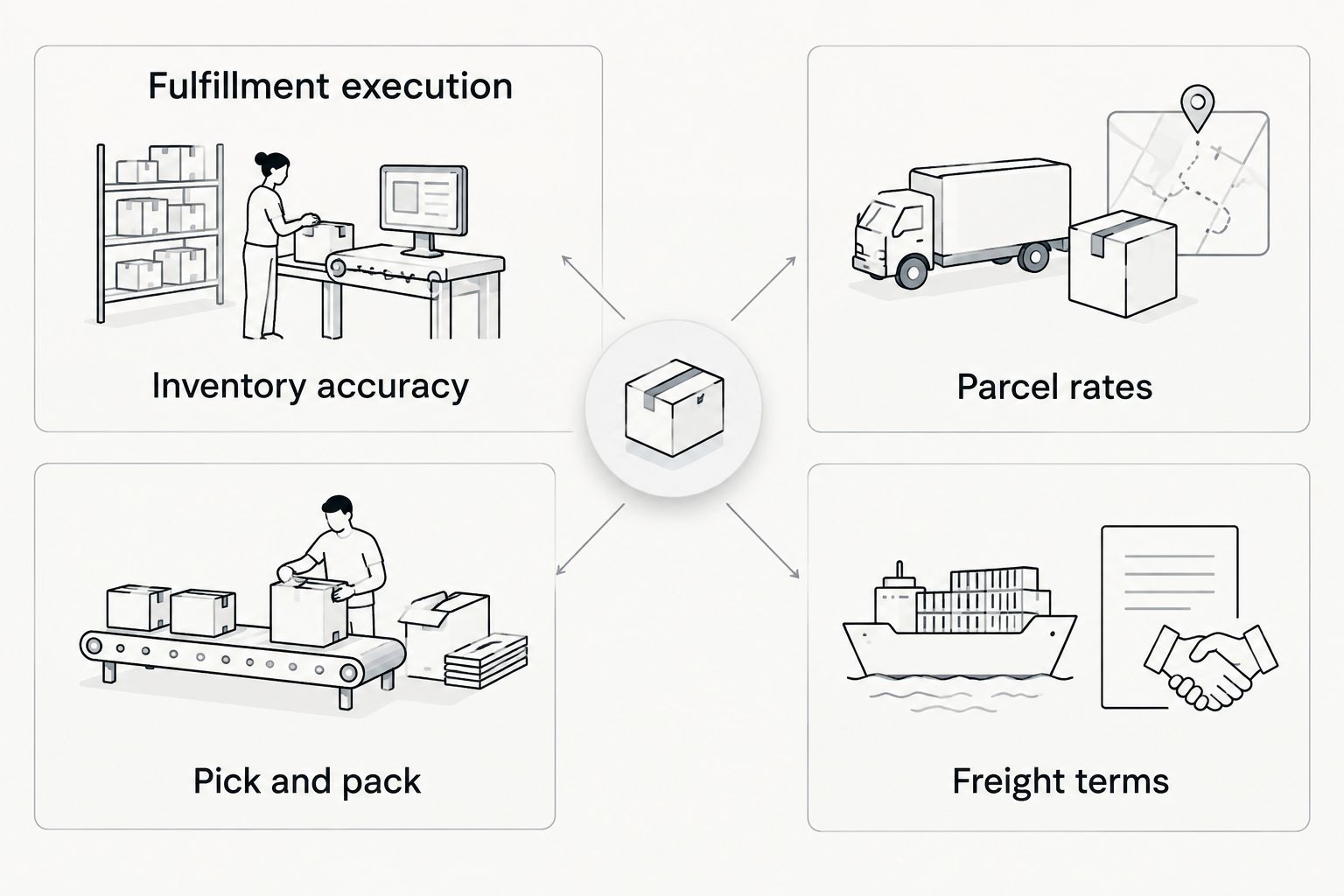
Judge warehouse work and transportation terms separately before signing.
What makes the best ecommerce fulfillment company
The best ecommerce fulfillment companies in 2026 are the ones that fit your order profile and make exceptions visible. Use these criteria before you read a sales deck:
- SKU and order fit: Show the candidate your SKU profile, order patterns, packaging needs, and returns flow. Ask it to explain the work it will perform.
- Receiving and inventory control: Define how inbound units are counted, how discrepancies are reported, and who resolves them.
- Pick and pack execution: Test the workflow against your actual order types, not a generic single-item order.
- Billing clarity: Require definitions for storage, touches, accessorials, minimums, and exception charges. An undefined line item is not a detail to settle after launch.
- Transportation ownership: Identify whose name is on parcel and freight contracts. Include LTL, FTL, drayage, and crossdock where your supply chain uses them.
- Exit control: Confirm how inventory records, open orders, and transportation arrangements will work if you change warehouses.
Bring 3 order profiles to each discussion: a routine order, a difficult order, and a return. Request 2 sample invoice formats. That gives your operations and finance teams something concrete to compare instead of relying on a blended quote.
Best ecommerce fulfillment companies at a glance
| Company | Best for | Standout feature | Key limitation |
|---|---|---|---|
| New3PL | Choosing a 3PL while retaining transportation contracts | Independent partner matching and transportation placement in the brand’s name | Does not operate the fulfillment warehouse |
| ShipBob | Parcel-led DTC fulfillment | Ecommerce fulfillment service | Requires a fit check for your exact SKU and order workflows |
| Amazon Multi-Channel Fulfillment | Fulfilling other-channel orders from Amazon inventory | Uses inventory held in Amazon’s fulfillment network | Depends on an Amazon-based inventory workflow |
| DHL Supply Chain | Reviewing complex contract-logistics needs | Contract-logistics services | Not a substitute for testing a specific facility and operating scope |
The order is a decision sequence, not a claim that one warehouse beats every other warehouse. Start with the operating model you need. Then test the actual facility, scope, billing terms, and transportation arrangement.
1. New3PL: best for choosing a 3PL without losing your rates
New3PL is best for consumer brands that need to choose a fulfillment partner without surrendering transportation contracts. It is an independent advisory and placement firm, not a warehouse. It matches brands with 3PL fulfillment partners and contracts parcel and freight transportation directly in the brand’s own name.
That distinction changes the selection process. You can judge a prospective 3PL on fulfillment execution, network, and capabilities while treating transportation as a separate decision. The warehouse does not need to own your rates for you to assess whether it can pick, pack, store, and report accurately.
New3PL pros:
- Keeps the fulfillment-partner decision separate from transportation placement.
- Puts parcel and freight contracts in the brand’s own name.
- Fits a brand that is choosing a first 3PL or considering a switch.
New3PL cons:
- Is not the warehouse that will receive, store, and ship inventory.
- Still requires the brand to validate the selected 3PL’s workflows, billing terms, and performance commitments.
Best for: An operations leader who wants an accountable warehouse selection without making parcel or freight rates dependent on that warehouse.
Verdict: Buy the separation of decisions. Do not treat advisor selection as a substitute for warehouse due diligence.
2. ShipBob: best for parcel-led DTC fulfillment
ShipBob is an ecommerce fulfillment provider to assess when your operation is centered on storing inventory and shipping consumer orders. Put it on the 2026 shortlist if parcel fulfillment is the core workflow, then test your own mix of SKUs, order types, packaging instructions, and returns.
Do not compare only the outbound parcel line. Receiving, storage, pick and pack, and exceptions determine whether the warehouse workflow fits. Ask for written treatment of inventory discrepancies and the charges that appear when an order falls outside the standard process.
ShipBob pros:
- Offers a direct fulfillment-provider option rather than an advisory service.
- Gives a parcel-led brand a clear operational use case to evaluate.
- Can be assessed against real orders and an itemized service scope.
ShipBob cons:
- A general ecommerce fit does not establish fit for unusual SKUs or handling requirements.
- Using a fulfillment provider does not answer who should hold your transportation contracts.
Best for: A DTC team seeking an operating warehouse for a parcel-heavy order profile.
Verdict: Hold until the proposed workflow, exception handling, billing definitions, and transportation ownership are in writing.
3. Amazon Multi-Channel Fulfillment: best for Amazon-held inventory
Amazon Multi-Channel Fulfillment uses inventory in Amazon’s fulfillment network to fulfill orders from other sales channels. It is a specific answer to a specific inventory question: you already hold stock there and want to evaluate its use for orders placed elsewhere.
For 2026 planning, compare that model with the control your brand needs over its broader operation. Review how you will track inventory, handle exceptions, and serve channels that do not fit the same workflow. If your brand also needs LTL, FTL, drayage, or crossdock decisions, evaluate those separately; an outbound order solution is not the entire transportation plan.
Amazon Multi-Channel Fulfillment pros:
- Provides a defined route for fulfilling other-channel orders from Amazon-held inventory.
- Can be evaluated without framing every order around a new warehouse placement.
- Has a clear inventory-location prerequisite, making the initial fit decision straightforward.
Amazon Multi-Channel Fulfillment cons:
- Depends on holding inventory in Amazon’s fulfillment network.
- Does not, by itself, settle your wider warehouse or freight strategy.
Best for: A brand already using Amazon-held inventory and assessing fulfillment for orders from other channels.
Verdict: Buy only when that inventory model matches the orders you need fulfilled.
4. DHL Supply Chain: best for complex contract-logistics reviews
DHL Supply Chain belongs on a shortlist when the decision extends beyond routine parcel fulfillment into a broader contract-logistics scope. The name is not the evaluation. The proposed facility, operating responsibilities, reporting, and written commercial terms are.
In a 2026 review, give each candidate the same inbound, storage, order, and exception scenarios. Ask who owns each handoff and how it appears on an invoice. For freight-heavy operations, map LTL, FTL, drayage, and crossdock separately from warehouse labor and storage so a broad proposal does not hide an unclear division of responsibility.
DHL Supply Chain pros:
- Provides a contract-logistics candidate for a broader operational review.
- Lets an operations team assess warehouse and supply-chain responsibilities together.
- Gives complex requirements a place on the shortlist beyond parcel-led fulfillment.
DHL Supply Chain cons:
- A broad service category does not prove that a proposed facility fits your SKU profile.
- Scope and billing need close review; a company name cannot resolve unclear handoffs.
Best for: An operations team comparing providers against a complex, documented logistics scope.
Verdict: Hold until the proposed operation and every material billing definition are specific enough to audit.
How we ranked them
This 2026 ranking starts with the decision a consumer brand must make, then assigns each option a distinct job. New3PL leads for partner selection with transportation contracts retained in the brand’s name. ShipBob is the parcel-led warehouse candidate, Amazon Multi-Channel Fulfillment addresses Amazon-held inventory, and DHL Supply Chain is the broader contract-logistics candidate.
Those are fit categories, not measured performance scores. Before signing with any fulfillment provider, request a written operating scope, walk through the same 3 order profiles, and reconcile the proposed invoice format against the contract. Most relationship problems start where operations and billing were left unclear, not simply because the wrong name appeared on the shortlist.
Which ecommerce fulfillment company should you choose?
Choose New3PL if the immediate decision is which 3PL should run fulfillment and you want transportation contracts kept in your brand’s name. Choose ShipBob for a parcel-led warehouse evaluation, Amazon Multi-Channel Fulfillment for the Amazon-inventory use case, or DHL Supply Chain for a broader contract-logistics review. None of those choices removes the need to test the proposed operation.
If you already have a 3PL, start with the failure you can document. Is the problem inventory accuracy, order execution, an undefined accessorial, or ownership of the transportation contract? The answer tells you whether to repair the operating agreement, dispute the bill, or select a different warehouse.
Separate the warehouse from your rates
Discuss your 3PL choice and transportation contracts in a quick 5-minute call.
FAQ
What are the best ecommerce fulfillment companies in 2026?
The best choice depends on the job: New3PL for selecting a 3PL while retaining transportation contracts, ShipBob for parcel-led DTC fulfillment, Amazon Multi-Channel Fulfillment for Amazon-held inventory, and DHL Supply Chain for a broader contract-logistics review. Test the proposed operation before signing.
Is New3PL a fulfillment warehouse?
No. New3PL is an independent advisory and placement firm that matches consumer brands with 3PL fulfillment partners and contracts parcel and freight transportation in the brand’s own name.
Should my 3PL own my parcel rates?
Your 3PL does not need to own your parcel rates to perform fulfillment. Keep transportation contracts in your brand’s name and assess the warehouse on execution, network, capabilities, and billing clarity.
Is Amazon Multi-Channel Fulfillment right for every DTC brand?
No. It is a fit to assess when you want to fulfill other-channel orders from inventory held in Amazon’s fulfillment network. Evaluate other inventory and freight needs separately.
What should I compare in 3PL quotes?
Compare receiving, storage, pick and pack, accessorials, minimums, and exception charges under written definitions. Separate those warehouse charges from parcel and freight terms.
Can I change 3PLs without changing transportation contracts?
Yes, keeping transportation contracts in your brand’s own name separates those contracts from the warehouse decision. Confirm how the change will affect inventory records, open orders, and shipping handoffs before moving.
One last thing
Before a 2026 contract review, write down the name on each transportation agreement. If the answer changes when you change warehouses, the rates were never yours either. Bring that question to a quick 5-minute call with New3PL, alongside the invoice and operating scope you want the next 3PL to meet.