Best overall for shelf-stable direct-to-consumer orders: ShipBob. Best for refrigerated or frozen distribution: Lineage. Best for retail-heavy distribution: DHL Supply Chain. The best 3PL for food and beverage brands depends on what must be stored, picked, shipped, and traced. new3PL is not a fulfillment warehouse; it helps consumer brands choose a 3PL while keeping parcel and freight contracts in the brand’s own name.
TL;DR
- ShipBob is the first shortlist pick for shelf-stable DTC food and beverage fulfillment; verify handling against your SKU profile.
- Lineage is the cold-chain shortlist pick; confirm unit-pick and order-channel fit before choosing it.
- DHL Supply Chain belongs on retail-heavy distribution shortlists; test its fit against your actual orders.
- new3PL helps brands choose a 3PL without moving transportation contracts out of the brand’s name.
Why this matters
A food or beverage brand can choose a capable warehouse and still end up with the wrong operation. Storage conditions, lot records, expiry handling, order accuracy, and retailer requirements must be written into the workflow. If the agreement leaves those details open, the first dispute arrives after inventory is already inside the building.
The same applies to billing. Receiving, storage, picking, packaging, and accessorials need clear definitions before launch. A recognizable 3PL name does not resolve an unclear statement of work. In 2026, compare how each provider would process your actual orders, not just whether it serves food and beverage clients.
Keep transportation separate. A 3PL should win the fulfillment decision on execution, network, and capabilities. Parcel, LTL, FTL, drayage, and crossdock need their own routing and rate decisions. new3PL helps brands make that split without surrendering rates held in the brand’s name.
What makes the best 3PL for food and beverage brands
Use these criteria before reading the ranking. The first question is not which provider has the largest network. It is whether the provider can follow the handling rules your products require.
- Product handling: Document required storage conditions, fragile-item handling, expiry rules, lot tracking, and any separation between product types. Ask the provider to show the workflow for each requirement.
- Order profile: Compare DTC units, retail cases, pallets, subscriptions, and promotional bundles against the provider’s proposed process. A strong pallet operation does not automatically make a strong each-pick operation.
- Inventory control: Establish how receiving discrepancies, damaged goods, holds, recalls, and returns are recorded. Define who can release held inventory and what evidence supports the decision.
- Network fit: Map warehouse locations against customers, suppliers, and retailer delivery points. A nearby facility matters only if it supports the handling and order flows you need.
- Billing clarity: Require definitions for receiving, storage units, picks, special handling, minimums, and accessorials. Run real order examples through the proposed invoice format.
- Transportation ownership: Decide who signs carrier agreements and controls the rates. Keeping those agreements in the brand’s name does not mean giving up on price; compare the complete rate and surcharge terms on the same shipment profile.
For a 2026 search, give each candidate the same SKU profile and order sample. A proposal built from different assumptions cannot settle which operation fits better.
Food and beverage 3PLs at a glance
These are shortlist picks by use case, not a claim that one warehouse can handle every food and beverage product. Confirm product acceptance, service scope, operating terms, and transportation arrangements directly with each candidate.
| Provider | Best for | Standout feature | Key limitation to test |
|---|---|---|---|
| ShipBob | Shelf-stable DTC orders | E-commerce fulfillment focus | Whether your product-specific handling and lot rules fit the proposed workflow |
| Lineage | Refrigerated or frozen distribution | Cold-chain focus | Whether DTC unit picking and returns fit your order profile |
| DHL Supply Chain | Retail-heavy distribution | Supply-chain and distribution scope | Whether the proposed site and process fit smaller DTC orders |
A table cannot tell you who owns an inventory discrepancy or how a special pick appears on an invoice. Those answers belong in the operating agreement. Use this 2026 ranking to narrow the first calls, then make candidates work through the same examples.
1. ShipBob: best 3PL for shelf-stable DTC orders
ShipBob is an e-commerce fulfillment provider. Put it on the shortlist when your food or beverage brand ships shelf-stable products as individual consumer orders and needs to evaluate an order-by-order fulfillment workflow. ShipBob is the best starting point here for shelf-stable DTC, not an automatic fit for every food product.
Give ShipBob the SKU list before discussing warehouse locations. Identify any product that needs expiry-based rotation, lot capture, fragile handling, or a different storage condition. Then ask for the receiving, picking, and exception steps in writing.
ShipBob pros:
- Its e-commerce focus makes DTC order handling a relevant starting point for the evaluation.
- You can test its proposed process against individual orders rather than judging it solely on pallet movement.
- It gives shelf-stable brands a distinct alternative to starting with a cold-storage specialist.
ShipBob cons:
- E-commerce focus alone does not establish that your exact food-handling rules are supported.
- A DTC shortlist decision does not settle retail-case, pallet, or freight requirements.
Best for: A shelf-stable brand whose main evaluation centers on individual consumer orders. Hold: Do not sign until ShipBob documents how it will handle your lot, expiry, exception, and billing requirements.
2. Lineage: best 3PL for cold-chain distribution
Lineage is a cold-chain logistics provider. Start here when refrigerated or frozen storage and movement shape the fulfillment decision. In 2026, a cold-chain shortlist should begin with the required handling conditions, not a general promise that a warehouse can store food.
Separate the work by order type. A brand moving pallets to distributors has a different pick and transport pattern from one shipping individual consumer orders. Ask Lineage to describe the exact services and site that would handle each flow; do not treat its wider network as proof that every location offers the same operation.
Lineage pros:
- Cold-chain logistics is central to its service scope.
- It is a relevant candidate when temperature requirements determine the warehouse shortlist.
- Its distribution focus gives brands a clear option to evaluate for larger shipment flows.
Lineage cons:
- Cold-chain capability alone does not establish a fit for DTC unit picking.
- The proposed site still needs to prove its handling, reporting, and exception process for your products.
Best for: A brand whose refrigerated or frozen distribution requirements lead the decision. Hold: Confirm the specific site, order types, temperature workflow, and billing terms before committing inventory.
3. DHL Supply Chain: best 3PL for retail-heavy distribution
DHL Supply Chain is a supply-chain and contract-logistics provider. It belongs on the shortlist when retail distribution, inventory flows, and freight coordination carry more weight than individual parcel orders. Evaluate the proposed operation, not the size of the company name.
Bring retailer routing requirements, carton rules, and delivery expectations to the first operational discussion. Ask which facility would perform the work and how exceptions would be assigned. If your brand also ships DTC, have DHL Supply Chain map that flow separately rather than assuming the retail process covers it.
DHL Supply Chain pros:
- Its contract-logistics scope makes it relevant to a retail-heavy evaluation.
- It can be assessed against warehouse and distribution requirements together.
- It gives brands with multiple order channels a candidate for a site-specific process review.
DHL Supply Chain cons:
- A retail distribution fit does not prove efficient handling of smaller consumer orders.
- Broad service scope does not replace written terms for the site and services you would use.
Best for: A brand whose retail distribution requirements drive warehouse selection. Hold: Require a site-level workflow and invoice examples before deciding whether DHL Supply Chain fits your order mix.
How to test the shortlist
The 2026 ranking gets you to a useful first conversation. It does not replace a process test. Send every candidate the same material, then compare the answers line by line.
- SKU profile: Select 3 SKUs with different handling needs. Include their storage requirements and any lot, expiry, or packaging rules.
- Order sample: Supply 30 days of orders, separated by DTC, retail, and other channels. Ask each candidate to map the receiving, pick, pack, and dispatch steps.
- Handling rules: Write down who records shortages, damages, holds, and returns. Ask what happens when the warehouse record and your inventory record disagree.
- Invoice test: Request 2 sample invoices built from the same order scenarios. Check which activity triggers each charge and where exceptions appear.
- Rate ownership: Identify every parcel and freight contract involved. Keep the warehouse selection separate from decisions about LTL, FTL, drayage, and crossdock.
The sequence matters. Do not compare invoices until each provider has priced the same work. Do not discuss carrier rates as though they answer whether the warehouse can pick accurately. new3PL helps brands compare 3PL execution while arranging transportation contracts directly in the brand’s name.
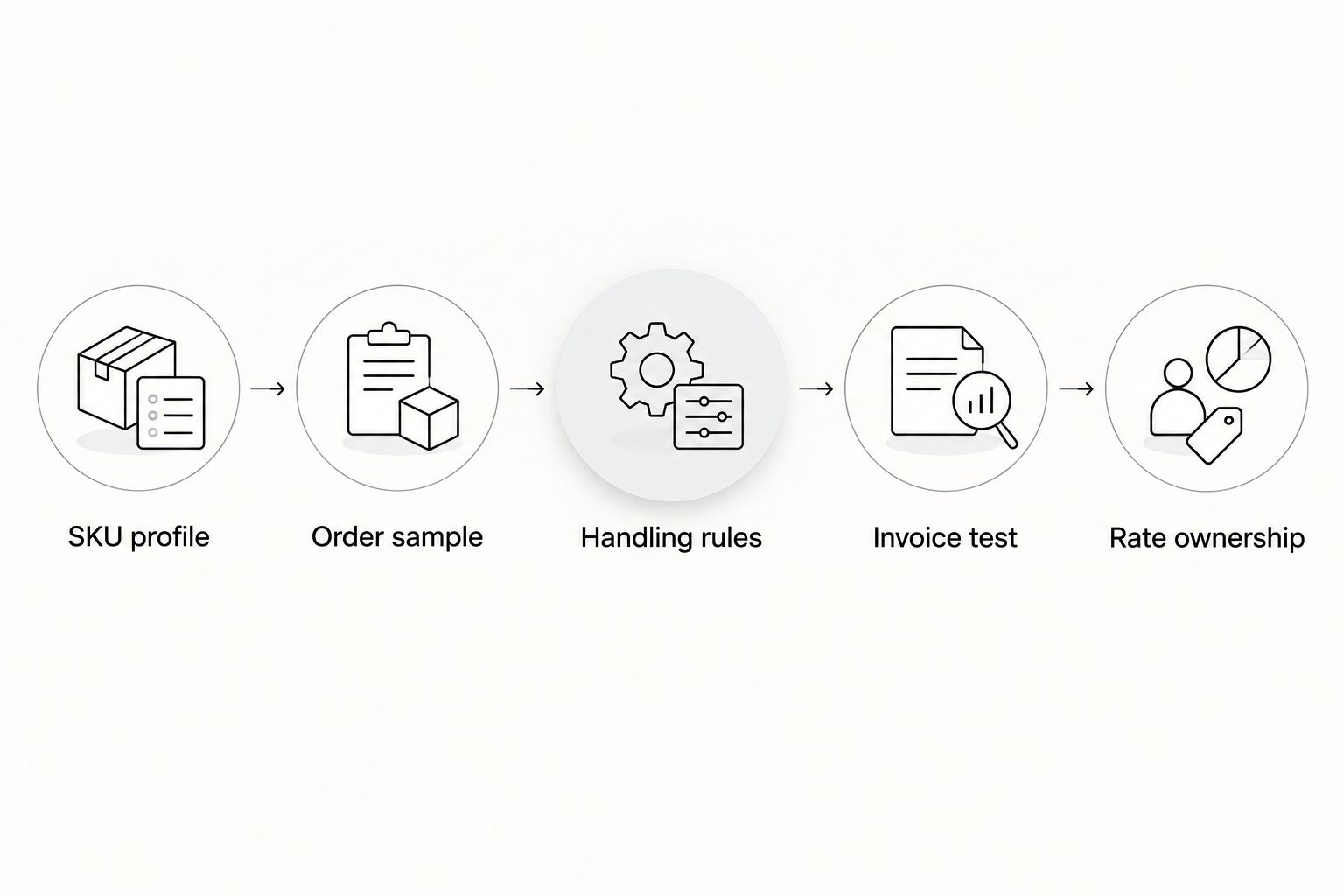
Test the warehouse workflow before making transportation part of the warehouse decision.
How we ranked these options
Each pick has a different job. ShipBob leads the shelf-stable DTC shortlist because e-commerce fulfillment matches that order pattern. Lineage leads the cold-chain shortlist because temperature-controlled logistics is the defining need. DHL Supply Chain leads the retail-heavy shortlist because distribution scope matters most in that case.
This is a fit ranking, not a measured service-level ranking. No provider earns a pass on inventory controls, billing, or the proposed site because it leads a category. new3PL treats those operating details and the brand’s transportation contracts as separate parts of the decision.
Which food and beverage 3PL should you choose?
For a shelf-stable DTC brand in 2026, start with ShipBob. For refrigerated or frozen distribution, start with Lineage. For retail-heavy distribution, start with DHL Supply Chain. If your orders span those patterns, run the same SKU and order test with more than one provider before choosing.
The default rule is simple: pick the 3PL for fulfillment, then decide transportation on its own merits. Keep rates in your brand’s name when you change warehouses. new3PL is an independent advisory and placement firm for brands that need to make those decisions without tying their carrier contracts to the 3PL they leave or choose.
FAQ
What is the best 3PL for food and beverage brands?
ShipBob is the starting shortlist pick for shelf-stable DTC orders, Lineage for cold-chain distribution, and DHL Supply Chain for retail-heavy distribution. The right choice depends on the product-handling rules, order mix, and proposed warehouse workflow.
Is a cold-storage provider necessary for every food brand?
No. The required storage and shipping conditions for your products determine whether cold-chain handling belongs in the shortlist. Document those conditions for each SKU before evaluating facilities.
Is ShipBob better than Lineage for a food brand?
ShipBob is the more relevant starting point for shelf-stable DTC evaluation; Lineage is the more relevant starting point when cold-chain distribution leads the decision. Neither focus proves fit for your specific products or order channels.
What should a food brand ask a 3PL about lot tracking?
Ask how lots are recorded at receiving, located in storage, selected during picking, and reported after shipment. Require the provider to explain how it handles discrepancies and holds.
Should a brand use its 3PL's parcel rates?
Not by default. Compare the complete parcel rate terms against a contract in the brand’s own name, and make the warehouse decision on fulfillment execution rather than bundled transportation.
Do food and beverage brands need to compare freight as well as parcel?
Yes. Review LTL, FTL, drayage, and crossdock wherever those flows appear in your operation. Parcel is only one piece of transportation.
How do you compare 3PL billing proposals?
Give each provider the same SKU profile and order sample, then request invoices for the same scenarios. Check receiving, storage, picking, minimums, and accessorials against the written operating terms.
One last thing
A warehouse change does not have to be a carrier-rate change. Keep that distinction in the contract review: confirm who owns the transportation agreements before inventory moves. For a quick 5-minute call about the shortlist and rate ownership, contact new3PL.
Talk through your 3PL shortlist
Discuss warehouse fit and transportation contracts in a quick 5-minute call.