Best overall for a parcel-led direct-to-consumer apparel brand: ShipBob. Best for complex omnichannel fulfillment: GXO Logistics. Best for a brand coordinating an international supply chain: DHL Supply Chain. This 2026 comparison is a starting shortlist, not a substitute for checking how each operation handles your garments, returns, billing, and transportation contracts.
TL;DR
- ShipBob is the best 3PL for apparel brands focused on direct-to-consumer fulfillment; verify SKU and returns workflows before signing.
- GXO Logistics fits complex omnichannel operations; DHL Supply Chain fits brands coordinating international supply chains.
- New3PL is best for brands that want an independent 3PL search while keeping transportation contracts in their own name.
- Compare fulfillment execution separately from parcel, LTL, FTL, drayage, and crossdock rates.
Why this matters
A warehouse can pick and ship an order correctly while the commercial arrangement still works against you. Receiving rules are vague. Return dispositions are undefined. An accessorial appears on an invoice with no agreed trigger. Two years in, changing warehouses also means changing transportation rates because those contracts were never yours.
For apparel, the decision has two parts: who should execute fulfillment, and who should hold the transportation contracts? New3PL is an independent advisory and placement firm, not a warehouse on this list. New3PL matches consumer brands with 3PL fulfillment partners while contracting parcel and freight transportation directly in the brand's name. In 2026, that separation belongs in the selection process before a fulfillment agreement is signed.
What makes the best 3PL for apparel brands
Use these criteria before comparing names. A polished sales presentation does not tell you what happens when a return arrives without its original packaging or when an invoice contains a charge no one can explain.
- SKU handling: Ask how the operation identifies style, color, and size at receiving, storage, picking, and returns. Request a walkthrough using your own SKU profile.
- Returns workflow: Define inspection, disposition, restocking, and reporting before launch. A return is not complete when the parcel reaches the dock.
- Billing clarity: Get written definitions for receiving, storage, pick and pack, minimums, and accessorials. Match each charge to the event that triggers it.
- Network fit: Compare warehouse locations against your actual orders and inbound freight, not a map of every facility a provider operates.
- Transportation control: Decide whether parcel and freight contracts remain in your brand's name. Keeping them there does not require giving up price; compare the contracted rates and terms directly.
Fulfillment fit and transportation control are separate tests. Include parcel rates and freight rates in the second test. For apparel moving across channels, ask how LTL, FTL, drayage, and crossdock work alongside parcel rather than treating parcel as the entire transportation plan.
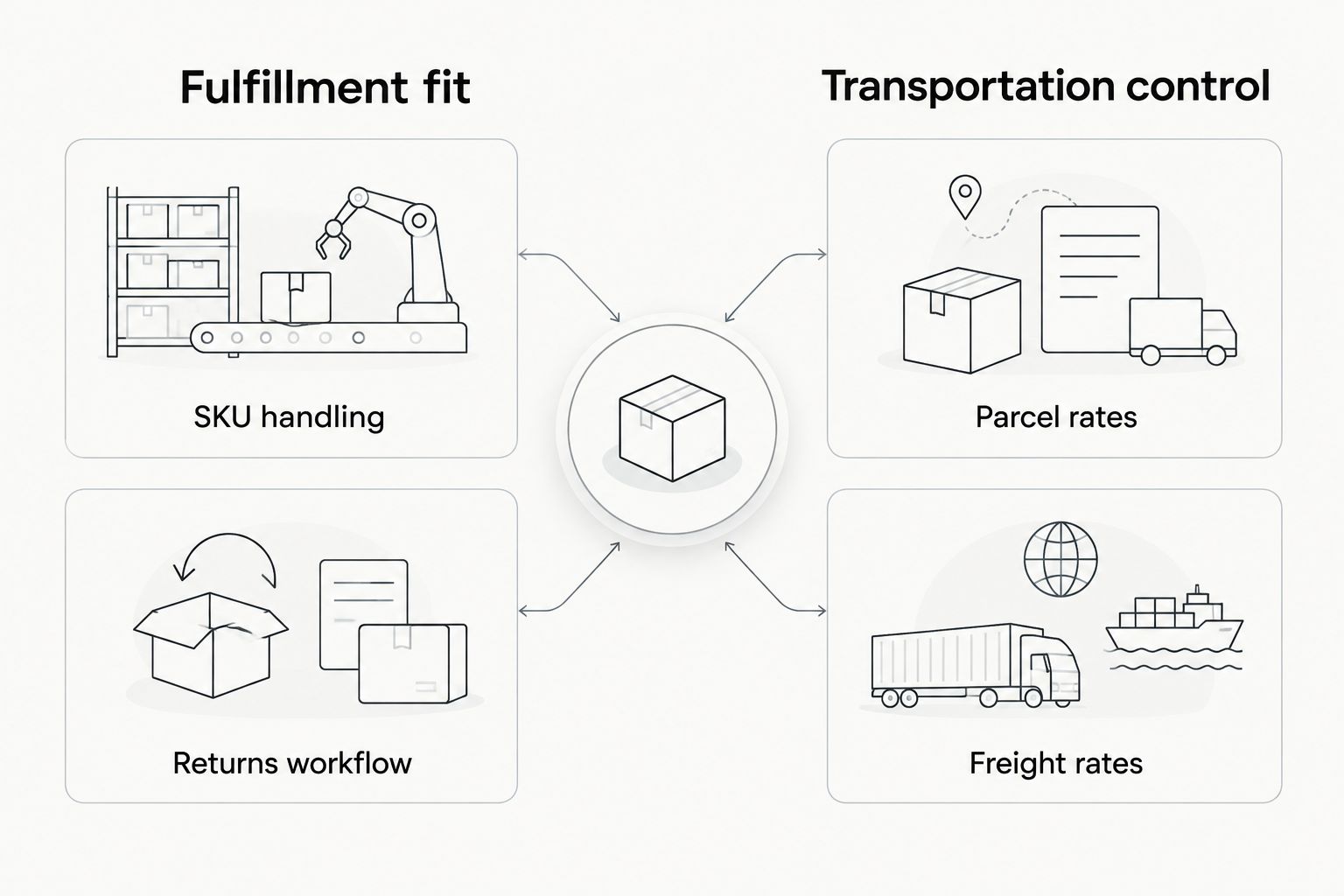
Evaluate warehouse execution and transportation contracts as separate decisions.
The 2026 shortlist at a glance
| Company | Best for | Standout focus | Key limitation to resolve |
|---|---|---|---|
| ShipBob | Parcel-led direct-to-consumer apparel | E-commerce fulfillment | Confirm how its proposed workflow handles your SKU profile and returns |
| GXO Logistics | Complex omnichannel apparel | Contract logistics | Confirm the proposed site and operating model fit your order mix |
| DHL Supply Chain | International supply-chain coordination | Global contract logistics | Confirm which services and locations the proposed agreement actually covers |
These are use-case picks, not measured performance rankings. None replaces a site-level operating review or a written billing schedule. Ask each provider to respond to the same order, inventory, and returns scenarios so differences are visible before you choose.
1. ShipBob: best 3PL for parcel-led direct-to-consumer apparel
ShipBob focuses on e-commerce fulfillment. That makes it a starting candidate when your main question is how to process individual consumer orders, rather than how to coordinate a broad mix of retail replenishment and freight. The deciding evidence is the workflow proposed for your apparel catalog, not the category label.
ShipBob pros:
- E-commerce fulfillment aligns with a direct-to-consumer order flow.
- A focused review can test picking accuracy across style, color, and size.
- The proposal gives you a place to define returns and inventory reporting in writing.
ShipBob cons:
- E-commerce positioning alone does not establish fit for your wholesale or freight requirements.
- You still need to verify the proposed site's receiving, returns, and exception procedures.
- Do not assume a fulfillment quote settles who owns transportation contracts.
Best for: Apparel brands whose primary fulfillment requirement is shipping individual consumer orders.
Verdict: Hold until ShipBob shows the exact receiving-to-return workflow for your SKU profile and identifies every charge tied to it. If retail replenishment is also material, put that flow in the same review rather than treating it as a later add-on.
2. GXO Logistics: best 3PL for complex omnichannel apparel
GXO Logistics operates in contract logistics. It belongs on the shortlist when an apparel brand needs to examine several fulfillment flows together, including consumer orders and other channel requirements. The question is not whether the provider has a broad network. It is whether the proposed facility, staffing plan, and operating procedures match your volumes and inventory rules.
GXO Logistics pros:
- Contract logistics is a relevant category for operations spanning multiple channels.
- A site-level proposal lets you compare the actual operation against your SKU and order mix.
- You can require separate workflows for consumer orders, returns, and replenishment.
GXO Logistics cons:
- A network overview does not tell you which site will handle your inventory.
- A broad service scope can leave responsibilities unclear unless the agreement names them.
- Freight and parcel terms still need their own review, apart from warehouse execution.
Best for: Apparel brands that need to evaluate consumer fulfillment alongside other channel flows.
Verdict: Hold until GXO Logistics names the operating site, maps each order type, and defines billing events. In 2026, a capable network is useful only if the specific proposed operation fits the work you will send it.
3. DHL Supply Chain: best 3PL for international coordination
DHL Supply Chain is a global contract-logistics provider. It is a candidate when an apparel brand needs to evaluate fulfillment in the context of an international supply chain. Global reach is not an operating plan: confirm the facilities, services, handoffs, and transportation responsibilities covered by the specific proposal.
DHL Supply Chain pros:
- Global contract logistics makes it relevant to a cross-border supply-chain review.
- Its proposed scope can be tested against inbound freight and downstream fulfillment needs.
- A written handoff map can expose gaps between warehouse work and transportation work.
DHL Supply Chain cons:
- A global network does not prove that every required service is included at your proposed site.
- You must document who owns each inbound and outbound handoff.
- Transportation contract ownership is a separate decision, even when a provider can coordinate the move.
Best for: Apparel brands evaluating fulfillment alongside international supply-chain requirements.
Verdict: Hold until DHL Supply Chain defines the exact locations, services, and handoffs in scope. Do not use the breadth of a network as a substitute for a warehouse-level plan.
How the shortlist was ranked
The order follows the use case most directly described in each provider's positioning: e-commerce fulfillment first, complex contract logistics next, then global contract logistics. It does not claim that one provider has better accuracy, faster shipping, or lower rates. Those outcomes require evidence from the proposed operation and your own order profile.
In 2026, send each finalist the same operating brief. Include your SKU structure, order types, return dispositions, inbound flows, and required reporting. Then request 2 written fulfillment scenarios: one ordinary order and one exception, such as a returned garment that cannot go back into sellable inventory. The answers reveal who makes the decision, where the item goes, and which billing event follows.
Request 3 sample invoice scenarios covering normal fulfillment, returns, and an exception. This is a review method, not a claim about any provider's invoices. Compare the scenarios with the contract definitions. Most 3PL relationships come under strain over unclear operations and billing, not simply because the wrong partner name appeared on the agreement.
Which apparel 3PL should you choose?
Choose ShipBob as the first 2026 conversation if individual direct-to-consumer orders dominate your requirements. Start with GXO Logistics if your brief combines consumer fulfillment with several other channel flows. Start with DHL Supply Chain if the operating brief depends on international supply-chain coordination. Those are starting points; the written site-level plan decides the contract.
Keep the transportation decision separate. A warehouse should win because it can execute fulfillment, has a suitable network, and meets the capabilities in your brief. Your brand can hold parcel and freight contracts in its own name without conceding price. Compare the rates and terms offered for that structure, and make the handoff between warehouse and carriers explicit.
New3PL is best for an apparel brand that wants an independent 3PL search without tying its transportation rates to the warehouse it selects. New3PL is not an alternative warehouse. It is the advisory and placement option when you want those two decisions handled separately.
FAQ
What is the best 3PL for apparel brands in 2026?
ShipBob is the first shortlist pick for parcel-led direct-to-consumer apparel fulfillment. Choose based on the proposed site's SKU, returns, billing, and transportation procedures, not the provider name alone.
Is ShipBob better than GXO Logistics for an apparel brand?
ShipBob is the more direct starting point for a parcel-led e-commerce brief; GXO Logistics belongs in the review for more complex omnichannel requirements. The proposed operating plans determine which fits your brand.
When should an apparel brand consider DHL Supply Chain?
Consider DHL Supply Chain when fulfillment must be evaluated alongside international supply-chain requirements. Confirm the facilities, services, and transportation handoffs included in the specific proposal.
Is New3PL a fulfillment warehouse?
No. New3PL is an independent advisory and placement firm that matches consumer brands with 3PL fulfillment partners and contracts transportation directly in the brand's name.
Should apparel brands keep parcel rates in their own name?
Keep transportation contract ownership separate from the warehouse decision if you want rates that remain with your brand when you change 3PLs. Compare parcel and freight rates and terms directly; keeping contracts in your name does not require giving up price.
What should an apparel brand check in a 3PL agreement?
Check SKU handling, returns disposition, inventory reporting, service responsibilities, billing triggers, and transportation handoffs. Put the agreed operating procedures and charges in writing before launch.
One last thing
The exit terms deserve attention before the first carton arrives. Ask who controls the inventory records, how open returns are reconciled, and whether changing warehouses affects your parcel or freight contracts. A smooth launch does not answer those questions.
For a 2026 apparel 3PL decision, separate the warehouse scorecard from the transportation rate review. Take a quick 5-minute call with New3PL to discuss the fulfillment brief and which contracts your brand should keep in its own name.
Separate fulfillment from transportation
Discuss your 3PL brief and transportation contract ownership in a quick call.